

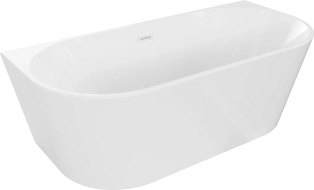
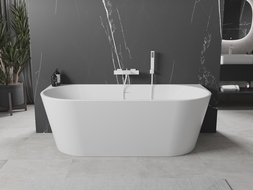




















Many homeowners face a significant challenge - they have small bathrooms where it's hard to find even a bit of space for a freestanding bath. In the case of such small, modest bathrooms, a corner bath or rectangular bath seems to be suitable. This solution allows for increasing the bath area while not taking up much space in the bathroom. Corner baths with attached handles and seats enhance comfort and safety during bathing, while rectangular ones are very versatile. Let's consider in this article how to install and connect a rectangular bath.
How to Install a Bath?
To connect a rectangular bath, several tools and fittings will be necessary, such as a spirit level, drainage installation, open-end wrench, drill driver, and items already included with the bath, like the panel, rails, legs, and all elements required for wall mounting.
- The first step is to attach the feet to the rectangular bath. It should be turned over gently placing it on a material that will protect it from scratching.
- Next, special rails need to be installed. Fortunately, all required bolts and screws should be included in the set. Legs attached to the rails will provide a solid foundation for the structure. It's worth remembering to attach the feet to the holes on the edge of the rails. This way, the spread will be wider, which will affect stability.
- The next step is the installation of the overflow-drain system. The siphon part should be at the bottom of the bath, while the overflow part should be on the side.
- At this point, it is worth trimming all hoses and pipes so that their length fits the set. One should not forget about gaskets which should also be included in the set.
- The next step is attaching the brackets. Users often unnecessarily skip this stage, exposing the bath to instability.
- The brackets should be tightly attached to the wall to facilitate the bath's adherence to side surfaces.
- At this stage, the bath level should be checked, for which a spirit level will come in handy. If adjustment is necessary, the height of individual sides can be set using the feet to achieve the desired level.
- For the shorter side, only 1 bracket is sufficient, while for the longer side, at least 2 brackets will be needed.
Bath Installation – Bath Panel
The next step is the installation of the bath panel. However, before this action, one should ensure that the drain is properly connected. The bath panel should be mounted using previously noted mounting strips or brackets. Which option will be available depends on the solution chosen by the manufacturer. Tabs are much easier to install. It's enough just to screw the brackets in the appropriate places and then put on the bath panel. The upper edge of the strip should hit the brackets on the bath, while the lower part of the strip should fit into the mounts on the floor.
The next step is to seal the bath panel. It is recommended to use silicone. Even the smallest gaps must be sealed so that the entire bath panel does not leak water. It's worth paying attention to the silicone chosen. Unfortunately, some of them react with acrylic. The solution will be sanitary silicone, which will not enter into such a reaction. Throughout the installation process of the rectangular bath, protective film should remain on its surface and the surface of each of its elements. It should only be removed after installation to avoid any scratches; however, at the moment of sealing, the film should already be removed.
The Frame Construction for a Rectangular Bath
In the case where the bath casing will be covered with tiles, it is necessary to create a solid frame and a base from plasterboard. This solution is most commonly used for rectangular and simple corner baths. If their edges are too curved, it can become too time-consuming. In such cases, it is best to rely on the ready-made casing provided by the manufacturer.
When planning the height of the frame, it is worth considering not only the height of the bath but also the protrusion of the edge relative to the basin. This rim usually has a height of 3 cm. Considering this, the frame should be 3 cm shorter. To be sufficiently solid, it should be 5.5 cm thick, while the single-layered plates covering it should be 6.5 cm. The frame from the frame can be easily obtained using one section of UD. It's enough to properly notch the bends and attach the frame using self-drilling screws. Such a solid frame can be mounted to the wall. It will provide a solid and durable support for the cladding of the corner and rectangular bath.